Clover Creek
About Clover Creek
What is Clover Creek?
Clover Creek is a 13.8 mile long creek located in Pierce County, Washington. The main surface water channel for the Chambers-Clover Watershed, Clover Creek rises from springs in South Hill and Fredrickson, flowing on through Spanaway, Parkland, McChord, and Lakewood before draining into Lake Steilacoom. Its drainage basin is 74 square miles, and tributaries include Spanaway, Morey, and the North Fork Clover creeks.
A Creek of Cultural and Ecological Significance
Clover Creek has long been a place of cultural, ecological, and community importance. Before European settlement, the creek and surrounding lands were home to the Coast Salish Sastuc band of Indians. Their primary village site was located near the area now associated with the Ichijo development and the former Brookdale Golf Course.
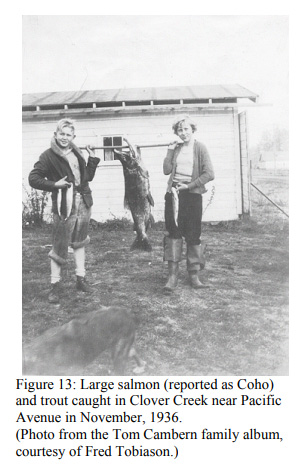
Settlers later noted the abundance of clover growing along the banks of the channel, which gave Clover Creek its current name. But long before that name, the creek supported a rich and living ecosystem. Historically, Clover Creek flowed abundantly year-round and provided habitat for all five species of Pacific salmon: Chinook, Pink, Coho, Chum, and Sockeye.
The creek also served as a vital water source for nearby communities, including Parkland and Tacoma. It was once described as a “winter river,” with seasonal flooding common during the rainy months. Together, its cultural history, salmon runs, year-round flow, and role as a drinking water source show that Clover Creek was far more than a drainage channel. It was, and remains, a defining feature of the surrounding landscape and community.
How Clover Creek Was Changed
Over the past hundred years, Clover Creek has undergone major changes. Today, the creek no longer flows year-round through much of its channel and is considered one of the most polluted creeks in Pierce County. The story of how this happened is tied to displacement, flood control, development, and decisions that altered the creek’s natural course.
The first and deepest harm was the removal of Indigenous people from the land they had stewarded for millennia. Under Governor Isaac Stevens, Native people were interned on Fox Island, where many starved. Survivors were later forced onto reservations at Puyallup, Nisqually, and Squaxin Island. The United States government then imposed systems of forced conversion and boarding schools in an attempt to erase Indigenous culture. Longhouse villages recorded at Sastuc, Sequalitchew, and along the shores of American Lake were destroyed.
At the same time, settlers began modifying Clover Creek for agriculture and flood control. Early records indicate that Clover Creek once joined Ponce de Leon Creek as a continuous channel, but was later rerouted into a new channel. Clover Creek also flowed into a wetland complex that, after being dammed, became Lake Steilacoom. These early modifications changed the landscape, but they did not stop the creek from flowing.
From Year-Round Flow to Seasonal Drying
The most damaging changes came in the 1940s. During the New Deal, a drainage district commissioner persuaded the Works Progress Administration to reroute Clover Creek despite local opposition. The new route conveniently directed the creek away from properties owned by the commissioner, which had experienced flooding.
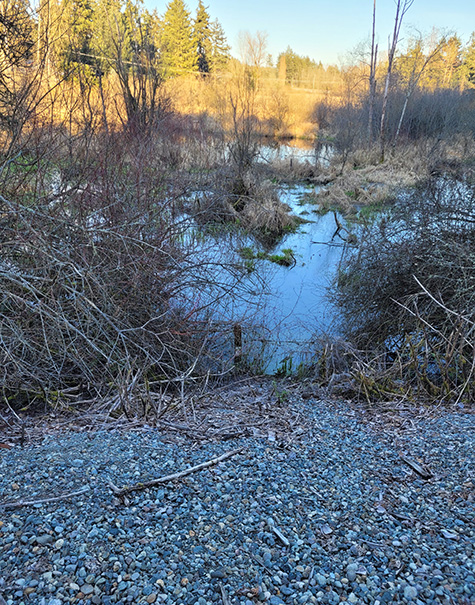
After this rerouting, Clover Creek went dry in the summer for the first time. Local residents said “the seal was broken,” and the commissioner was eventually recalled from public office.
Later, Clover Creek was rerouted again through parts of Parkland into an asphalt-lined creek bed. Its original channel, which once ran through what is now Pacific Lutheran University, disappeared. The construction of McChord Air Force Base also transformed the watershed by paving over a wetland complex known as Schibig Marsh. Clover Creek was then channeled through a culvert beneath the McChord runway.
In Fredrickson, a railroad was built over some of the best upstream salmon spawning habitat near the Naches Trail. This restricted flow and turned the area into a marsh.
Despite these changes, salmon runs continued to be recorded in Clover Creek until the 1980s. Since then, rapid development and increasing pressure on the aquifer have further reduced the creek’s ability to recharge and sustain flow. Groundwater that once fed the creek has also been drawn directly for drinking water.
Restoring the Creek, Restoring the Community
Clover Creek is an indicator of the health of the surrounding environment and community. Today, that health is poor. The creek’s decline reflects more than environmental damage. It reflects a long history of displacement, rerouting, wetland loss, development pressure, and decisions that separated the community from the natural systems that sustain it.
Restoring Clover Creek will require more than isolated improvements. It will require acknowledging the creek’s history, repairing damaged habitat, protecting groundwater, restoring wetlands where possible, and reimagining the relationship between people and the watershed.
The future of Clover Creek can be different from its recent past. By working together, the community can help restore a living creek where salmon, wildlife, and people can thrive together.
Get Involved
Take Action / Volunteer
Amplify our impact—join us in breaking barriers, planting trees, and organizing on‑the‑ground restoration activities.
Donate Today
Fuel our work restoring the watershed and supporting salmon recovery with your donation.